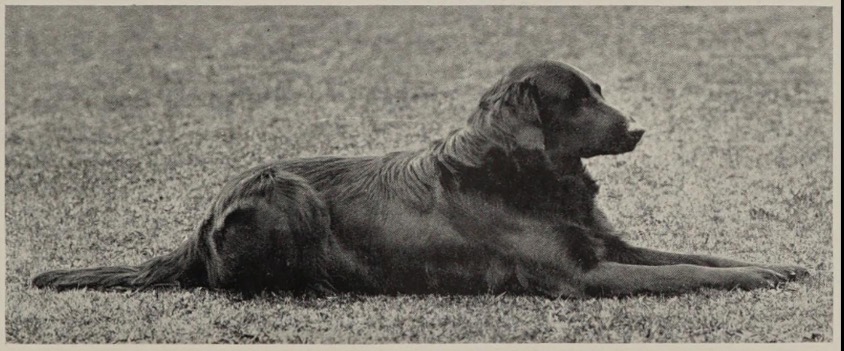
| Dual Ch. Toby of Riverside, bred and owned by H. Reginald Cooke.
Source: Ash, E. C. (1927). Dogs: their history and development, volume I. Boston, Massachusetts: Houghton Mifflin Company
https://yesbiscuit.com/2023/09/01/vintage-flatcoated-retrievers/?amp=1
The phenomenon was evident in the Flatcoat. If we look at Grouse of Riverside (b.1903), one of the two Flatcoated dual champions ever in Britain, he had an almost complete pedigree for six generations. The Flatcoat dominated the Field Trial scene during these early years and Labradors were hardly visible. But the other dual Champion, Toby of Riverside (b.1919), had an unregistered mother and an unregistered grandmother and great grandmother on the sires side. Most dogs in the latter's pedigree were most likely pure-bred Flatcoats, as otherwise the show quality wouldn’t be there, but it’s not a wild guess that the working Labrador blood is there as well quite close behind, knowing about the total dominance of the working Labrador on top Field Trial level at that time. There are no known descendants of Grouse but Toby played a key role for the working Flatcoat lines.
When studying Flatcoat pedigrees back to the decades before World War II, there are more frequent gaps in the working dog pedigrees compared with the show ones. Even if most of those dogs were pure Flatcoats there’s a good reason to believe there are the odd Interbreds as well. The strong dominance of the Labrador on the Field Trial scene and the openness when it came to interbreeding must have encouraged pro work breeders to use the best possible blood.
Being a numerically small breed, it could be expected that interbreeding had been used in larger scale in the Flatcoat. But surprisingly there are only a few well-known cases of interbreeding since the nineteen twenties. Nevertheless, they have played an important role in the building of the working Flatcoat. A Labrador named Flapper, who might have been the famous FT Ch Flapper, appears in the early Ponsbourne pedigrees coming from a Welsh working line. The by far most influential one was the Labrador Coronation Jenny being the grand dam of the Interbred retriever, Bibby. She was mated to Dual Ch. Toby of Riverside and to Dandie of Shipton and her offspring came to play a major role in the working lines. Her most famous offspring was FT Ch Elwy Mary and in addition to that six others won stakes and in the coming generations her impact is obvious.
But no one should claim that the qualities in the major working Flatcoat lines are fully due to a continuous infusion of working Labrador blood. There has always been strong working Flatcoat lines. The game finding capability in a good working Flatcoat is second to none but the infusion of working Labrador blood has added a finetuning of the working capabilities, faster maturation, improved steadiness and biddability and, not the least, it broadened the narrow gene pool.
Mr Reginald Cook, of the Riverside prefix, is one of the finest exponents of a dual-purpose breeder in any breed looking back on his two dual champions in the dawn of the nineteenth century, fifty years of successful dual-purpose breeding and on his last Field Trial winners after WWII. He must be seen as one of the strongest supporters ever of the working Flatcoat, starting his career with the outstanding worker Dual Ch Grouse of Riverside born in the beginning of the nineteenth century, following up with Dual Ch Toby of Riverside during the nineteen tenth and making a grand final with Joy of Riverside (handled by Cooke’s keeper) winning the FCRS All Aged stake 1949 and 1950 and becoming second in 1951, the year of her owner’s death. Joy was the maternal half sibling of Nobby of Riverside who was second in the Flat Coated Retriever Association's last Field trial in 1948 and third behind Joy in the first FCRS Field Trial in 1949. Nobby was the grandsire of Teal of Hawks Nest |